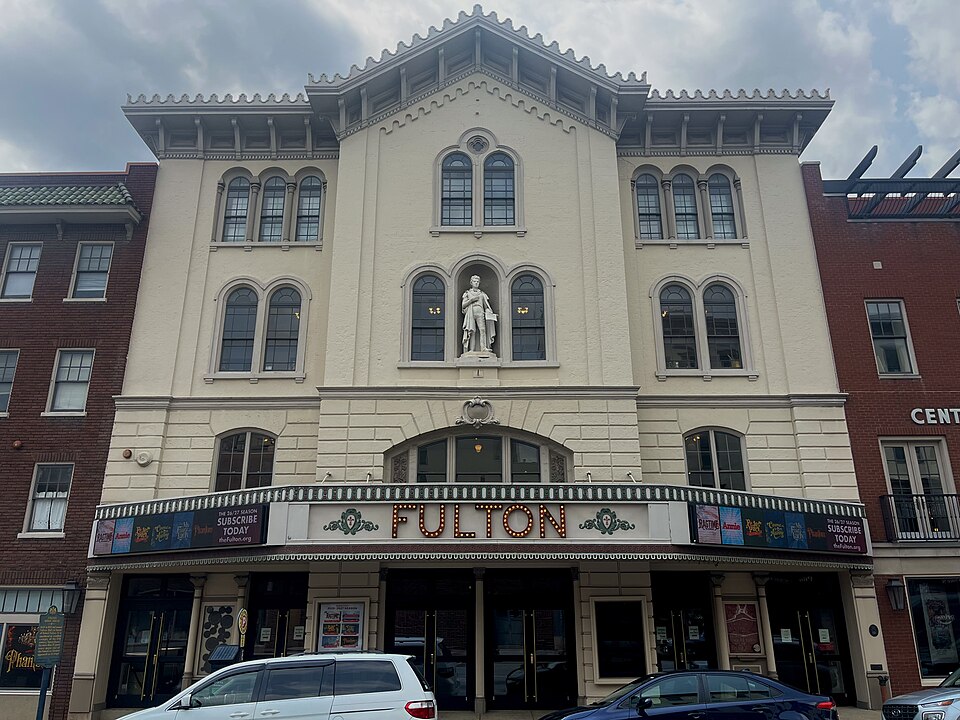
On days where campus feels too quiet and the food feels a little too stale, it is not uncommon for Millersville students to take the short trip to Lancaster City. Home to Millersville’s Ware Center for the Arts, as well as a variety of museums and shops, one location that stands out among the crowd is the Fulton Theatre, located at 12 N. Prince Street.
This popular landmark provides productions to the Lancaster community, but it also has one of the richest histories of any theater in the United States. The Fulton Theater is unique because before it was a theater, it was the Lancaster County jail. This jail, while still partially preserved, holds a tragic history. In 1763, the Paxtang Boys murdered the last Conestoga Native Americans who were being kept protected at the jail. They were never held accountable for their crime.
In 1852, the jail was demolished and the Fulton Theatre was built atop it. It was named after Robert Fulton, a successful engineer and Lancaster native. Throughout its early years, it served a variety of roles — it originally operated as both a town hall and a theater stage, as well as a hospital throughout the American Civil War. Notable orators such as Thaddeus Stevens spoke there, and significant historical figures such as John Wilkes Booth performed there. Around this time, Lancaster’s chief law enforcement officer David Miller released two formerly enslaved women who were imprisoned and were set to be transported to the South. This was formally recognized by the government as a connection to the Underground Railroad in 2008.
As the venue continued to become more well-established, the owners decided to renovate the building to serve as an opera house. This renovation commenced, and a new grand opening was held in 1873. Traditional theatrical performances continued to happen, with a notable one being the performance of “Othello” during the grand opening which helped support causes related to the Civil War.
When technology for showing movies was implemented in 1930, other productions were almost completely removed. This led the Fulton Opera House to face risks of demolition. However, dedicated citizens of Lancaster formed the Fulton Opera House Foundation, which allowed it to remain in the city and operate as it used to. Movies were eventually no longer shown as the profits were no longer necessary.
The formation of this foundation marked a huge turnaround for the theater and led it to thrive. The Actors Company of Pennsylvania made its way to the Fulton around 1969. During this year, the building was also officially placed on the National Register for Historic Buildings, which is not an easy feat. Its place on the National Register continues to assist in the building’s protection and preservation. In fact, it is one of only eight theatres in the United States that made its way onto the list.
In 1983, the Fulton became associated with the Actor’s Equity Association, and started their touring program, the Theatre for Young Audiences program. In 1995 and 1996, the venue became associated with the Actors’ Company of Pennsylvania for their season at the time, and are still a part of the company to this day.
Today, the Fulton Theatre continues to be an important part of Lancaster City’s culture and arts scene. It has operated as a nonprofit since 1965, and continues their 1989 implementation of pay-want-you-want tickets.
If you want to see a show in the United States’ oldest working theater, they have two upcoming productions for the fall: Ragtime, which ends on Oct. 18, and Annie, which runs from Nov. 20 to Dec. 31.